ETF vs Mutual Fund – Which is better
In today’s fast-growing financial world, investors are constantly looking for smart and efficient ways to grow their money. Two of the most popular investment options are ETFs (Exchange-Traded Funds) and Mutual Funds.
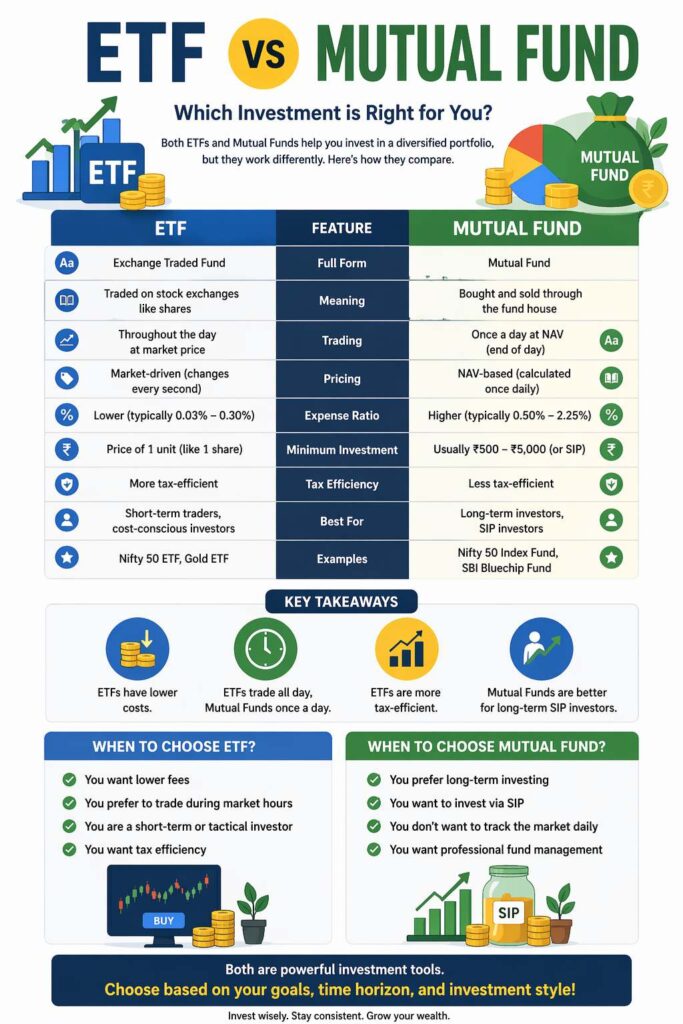
At first glance, both may look similar because they pool money from investors and invest in financial assets. However, their working style, cost structure, and flexibility are quite different.
If you are confused about which one to choose, this detailed guide will help you understand everything in a simple and practical way.
Understanding ETFs (Exchange-Traded Funds)
An ETF is a type of investment fund that is listed and traded on stock exchanges, just like shares. It usually follows a specific index, sector, or asset class.
Instead of trying to beat the market, ETFs aim to replicate market performance.
Key Highlights of ETFs
- Bought and sold during market hours
- Price keeps changing like stocks
- Generally follows an index
- Lower management cost
- Requires Demat and trading account
Example
If you invest in a Nifty 50 ETF, your money is spread across top companies in India, giving you diversification automatically.
Understanding Mutual Funds
A mutual fund collects money from multiple investors and invests it in various financial instruments like stocks, bonds, or a mix of both.
Unlike ETFs, most mutual funds are actively managed, meaning a fund manager takes decisions to try and generate higher returns.
Key Highlights of Mutual Funds
- Investment via SIP or lump sum
- Managed by professionals
- No need to track market daily
- Available in multiple categories
- Can be bought without Demat
Core Difference Between ETF and Mutual Fund
The biggest difference lies in how they are traded and managed.
| Feature | ETF | Mutual Fund |
|---|---|---|
| Trading Style | Real-time buying/selling | End-of-day NAV |
| Management | Passive | Active or Passive |
| Cost | Lower | Slightly higher |
| Flexibility | High | Moderate |
| Accessibility | Needs Demat | Easy for beginners |
Expense Ratio: Hidden Game Changer
One of the most important factors in investing is cost.
ETFs are known for their very low expense ratio, which means you keep more of your returns.
On the other hand, mutual funds charge higher fees because of active management.
👉 Over a long period, even a 1% extra fee can reduce your total returns significantly.
Returns: Which One Performs Better?
There is no fixed answer, but here’s a practical understanding:
- ETFs give returns similar to the market (stable and predictable)
- Mutual funds can outperform or underperform depending on the fund manager
In recent years, many investors prefer ETFs because:
- They avoid human bias
- They follow market trends consistently
Advantages of ETFs
ETFs are becoming popular for a reason.
- Cost-effective investment option
- High transparency
- No dependency on fund manager decisions
- Ideal for long-term wealth creation
- Easy diversification
Limitations of ETFs
Despite their benefits, ETFs also have some drawbacks:
- Requires Demat account
- Brokerage charges may apply
- Not beginner-friendly for complete newbies
Advantages of Mutual Funds
Mutual funds are still the first choice for many investors.
- Professionally managed
- Easy to start through SIP
- No need for market knowledge
- Wide range of options available
- Suitable for beginners
Limitations of Mutual Funds
- Higher management fees
- No real-time trading
- Performance depends on fund manager skills
Which One Should You Choose?
The right choice depends on your investment style.
Go for ETFs if:
- You want low-cost investing
- You prefer long-term strategy
- You are comfortable using Demat account
- You believe in passive investing
Go for Mutual Funds if:
- You are a beginner
- You want automatic SIP investment
- You prefer expert management
- You don’t want to track market regularly
Smart Strategy (Recommended)
Instead of choosing one, a smarter approach is to combine both.
A simple strategy can be:
- 50% in Index ETF
- 50% in Mutual Fund SIP
This way, you get:
- Cost efficiency
- Professional management
- Balanced risk
ETF vs Mutual Fund: Final Conclusion
Both ETFs and mutual funds are powerful investment tools. The best option depends on your financial goals, risk tolerance, and experience.
If simplicity is your priority, mutual funds are a great starting point.
If you want efficiency and lower cost, ETFs are the better choice.
For most investors, a combination of both works best in the long run.
FAQs (Frequently Asked Questions)
1. Is ETF better than mutual fund?
ETFs are better in terms of cost and transparency, while mutual funds are better for beginners due to ease of investment.
2. Can beginners invest in ETFs?
Yes, but basic knowledge of stock market and Demat account is required.
3. Do ETFs give higher returns than mutual funds?
Not necessarily. ETFs match market returns, while mutual funds may perform better or worse depending on management.
4. Is SIP available in ETFs?
Direct SIP is not available, but you can invest regularly using broker platforms.
5. Are mutual funds safer than ETFs?
Both carry market risk, but diversified funds (like index funds) are relatively safer.
6. Should I invest in both?
Yes, combining ETFs and mutual funds can create a balanced and efficient portfolio.
Disclaimer
This content is for educational purposes only and should not be considered financial advice. Investments in financial markets are subject to risks. Always do your own research or consult a financial advisor before investing.

Shree
Founder & Content Research Analyst – FreeJobAlertt.com
“I am a content researcher and publisher specializing in Government Job Notifications, Recruitment Updates, Sarkari Schemes, Admit Cards, Syllabus, and Results. With over 4 years of experience, I focus on providing verified and reliable information collected from official government portals, employment news sources, and state recruitment boards.
My objective is to deliver accurate, timely, and well-explained updates to help students and job seekers access authentic information without confusion. I ensure every post includes clear details such as eligibility, selection process, exam pattern, age limits, important dates, and step-by-step application guidelines.
Transparency, trust, and user-focused content are the core values behind my work, making FreeJobAlertt.com a dependable platform for Government Job and Recruitment information.”