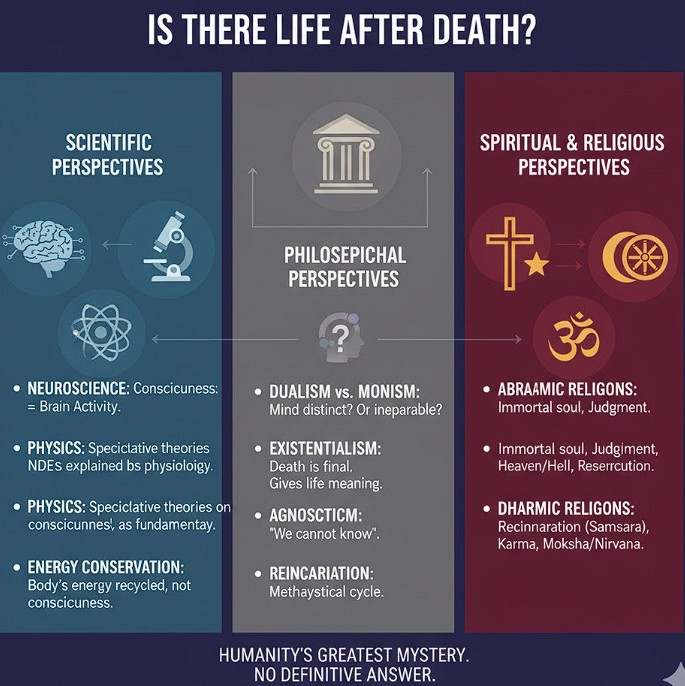
Introduction: The Eternal Question
“Is there life after death?” — a question as old as humanity itself. Every culture, religion, and civilization has tried to find answers to what happens when we take our last breath. Some believe in heaven, reincarnation, or the continuation of consciousness, while others see death as the final end — the quiet conclusion of biological existence.
is there life after death question is more than just curiosity. It touches our deepest fears, hopes, and understanding of existence. In this post, we will explore whether there is life after death from scientific, philosophical, and cultural perspectives, without bias or judgment.
1. Understanding Death: The Biological Perspective
From a scientific standpoint, death is the point at which the body ceases to function — the heart stops beating, the brain loses activity, and vital organs shut down. Medical science defines “clinical death” as the moment when the body can no longer sustain life.
Yet, even within biology, there are mysteries. In some rare cases, people declared clinically dead for minutes — or even hours — have been revived through advanced medical techniques. Their experiences often become the foundation for what we call “near-death experiences” (NDEs).
While science agrees that biological life ends, it does not fully explain what happens to consciousness — the sense of “I” or self-awareness — after physical death. This question remains open to interpretation.
2. The Mystery of Consciousness
Consciousness is one of the most complex and least understood phenomena in science. Neuroscientists can trace brain activity, map neural networks, and measure responses, but the origin and persistence of consciousness are still debated.
Some theories, like materialism, state that consciousness arises entirely from brain processes — meaning when the brain dies, consciousness disappears. Others propose non-material theories, suggesting consciousness might exist beyond the physical brain, possibly as energy or a separate dimension.
This idea gives rise to the argument that life after death could exist — not as a physical continuation, but as a form of consciousness beyond matter.
3. Near-Death Experiences (NDEs): Clues or Illusions?
One of the most discussed evidences supporting the belief in life after death is the Near-Death Experience. People who have been revived after cardiac arrest often describe similar sensations:
- Floating above their body
- Seeing a bright light
- Meeting deceased loved ones
- Feeling immense peace and detachment
Researchers such as Dr. Raymond Moody and Dr. Sam Parnia have studied thousands of these cases. Some argue these experiences are caused by chemical reactions in a dying brain, lack of oxygen, or the release of endorphins.
Others claim these accounts hint at the existence of consciousness beyond the brain, suggesting that death might be a doorway, not an end.
4. Religious and Spiritual Interpretations
Every religion offers its own perspective on is there life after death:
- Christianity: Believes in Heaven and Hell, where the soul is rewarded or punished based on one’s deeds.
- Hinduism: Emphasizes reincarnation — the soul takes new birth based on karma.
- Buddhism: Views rebirth as a cycle of suffering until enlightenment is reached.
- Islam: Teaches resurrection and eternal life after the Day of Judgment.
- Spiritualism & New Age Thought: Suggests the soul continues its journey in another dimension of existence.
Although these beliefs differ, they all share one message — that death is not the end but a transition to another form of being.
5. The Scientific Skepticism
Despite thousands of personal accounts and spiritual beliefs, mainstream science remains cautious.
Most scientists argue that there is no empirical evidence proving consciousness survives death. They see experiences like visions, lights, or sensations as hallucinations triggered by the dying brain.
However, recent studies in quantum physics and neuroscience are beginning to challenge traditional views. Some researchers, like physicist Roger Penrose, propose that consciousness might be linked to quantum processes that could exist beyond the body. While this doesn’t confirm life after death, it opens new possibilities worth exploring.
6. The Psychological Impact of Belief in Life After Death
Believing in is there life after death significantly affects human psychology.
- It gives comfort during grief and loss.
- It reduces fear of death.
- It shapes moral behavior, encouraging people to live with purpose.
On the other hand, disbelief can also foster a realistic, present-focused life, emphasizing that our time on Earth is precious and limited.
Either way, this belief — or disbelief — influences how we live, love, and find meaning.
7. Philosophical Reflections: What If Death Is Not the End?
Philosophers like Plato and Immanuel Kant discussed the soul’s immortality centuries ago.
Plato believed the soul existed before birth and continued after death, while Kant argued that moral justice demands a form of life beyond death to balance good and evil.
Modern thinkers also debate this idea. Some say life after death gives meaning to morality and consciousness. Others claim that meaning comes not from eternity, but from how we use our finite time wisely.
8. What Does Modern Research Say?
Recent research projects like the AWARE Study (Awareness During Resuscitation) conducted by the University of Southampton examined hundreds of cardiac arrest survivors.
A small percentage reported verified experiences — like seeing things that occurred in the room while they were “clinically dead.” Though controversial, such cases keep the debate alive.
Meanwhile, technological innovations like AI consciousness mapping and digital immortality — uploading memories and mind data — bring a new angle: Can we create life after death digitally?
9. Life After Death in Different Cultures
Cultural traditions worldwide view death differently:
- Ancient Egyptians believed in an afterlife journey guided by gods.
- Native American tribes often saw death as a transformation into spiritual energy.
- Japanese Shinto beliefs view spirits as eternal presences that stay connected to nature.
These shared beliefs across civilizations suggest a deep human intuition that something — perhaps consciousness, energy, or essence — continues beyond physical death.
10. Conclusion: Between Mystery and Meaning
So, is there life after death?
Science has yet to prove it, philosophy keeps questioning it, and spirituality continues to affirm it.
Maybe the truth lies somewhere in between — that death is neither a complete end nor an easy continuation, but a transformation we cannot yet comprehend.
Whether life after death exists or not, the question itself teaches us to live more meaningfully — to cherish every moment, act with kindness, and seek purpose beyond material existence.
In the end, perhaps the best answer is this:
“Life after death” begins with how deeply we live before we die.
FAQs About Life After Death
Q1. Is there any scientific proof of life after death?
No definitive proof exists. Some studies on near-death experiences suggest consciousness may persist briefly after death, but there’s no conclusive evidence.
Q2. What happens to the soul after death?
Different religions describe various journeys — from reincarnation to resurrection. Scientifically, the concept of “soul” is still unproven but remains a central part of spiritual belief.
Q3. Why do people believe in life after death?
It provides hope, comfort, and meaning. Humans naturally seek continuity and fear the idea of complete extinction.
Q4. Can consciousness exist without the brain?
This remains an open scientific question. Some theories in quantum mechanics suggest it might, but there’s no verified proof.
Q5. What is the best way to prepare for death?
Live consciously. Value relationships, act ethically, and find peace in the present moment — whether or not there’s life after death.
SEO Keywords Used:
Is there life after death, what happens after death, life after death evidence, near death experiences, scientific proof of life after death, consciousness after death, philosophical view on life after death.

Shree
Founder & Content Research Analyst – FreeJobAlertt.com
“I am a content researcher and publisher specializing in Government Job Notifications, Recruitment Updates, Sarkari Schemes, Admit Cards, Syllabus, and Results. With over 4 years of experience, I focus on providing verified and reliable information collected from official government portals, employment news sources, and state recruitment boards.
My objective is to deliver accurate, timely, and well-explained updates to help students and job seekers access authentic information without confusion. I ensure every post includes clear details such as eligibility, selection process, exam pattern, age limits, important dates, and step-by-step application guidelines.
Transparency, trust, and user-focused content are the core values behind my work, making FreeJobAlertt.com a dependable platform for Government Job and Recruitment information.”