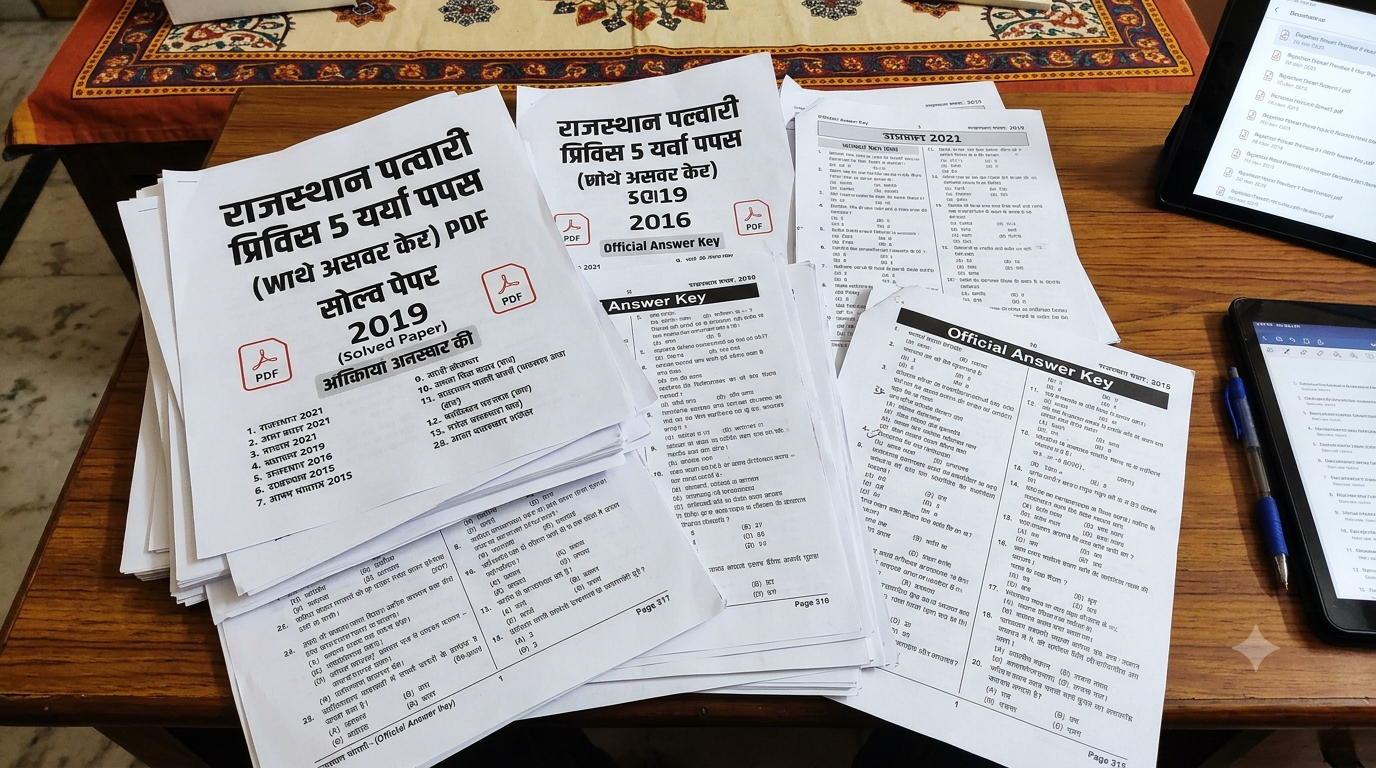
Preparing for the Rajasthan Patwari examination becomes easier when candidates understand the types of questions asked in previous exams. The Rajasthan Patwari Previous Year Paper with Answer Key helps candidates understand the examination pattern, identify important subjects, practise time management, and evaluate their preparation before the actual examination.
Candidates preparing for the upcoming Rajasthan Patwari recruitment can use previous question papers as a practical study resource. However, they should always check whether a paper belongs to the official examination, a previous recruitment cycle, or a practice test prepared for preparation purposes.
Rajasthan Patwari Previous Year Paper: Overview
| Particulars | Details |
|---|---|
| Exam Name | Rajasthan Patwari Examination |
| State | Rajasthan |
| Exam Conducting Authority | Rajasthan Staff Selection Board (RSSB) |
| Article Topic | Previous Year Question Paper with Answer Key |
| Exam Level | State-Level Recruitment Examination |
| Main Purpose | Practice and exam preparation |
| Useful Study Material | Previous papers, answer keys, syllabus and mock tests |
| Paper Availability | Depends on the examination cycle and official release |
| Official Website | RSSB official website |
Candidates should verify the latest recruitment notification for the applicable examination scheme, syllabus and marking rules before beginning their preparation.
Why Rajasthan Patwari Previous Year Papers Are Important
Reading books and completing the syllabus are essential, but practising actual examination questions provides a different kind of preparation. Previous papers help candidates understand how theoretical concepts are converted into objective questions.
1. Understand the Question Pattern
Previous papers help candidates become familiar with the wording, difficulty level and structure of questions. They can also reveal which topics require additional practice.
2. Identify Important Subjects
Regular practice can help candidates identify subjects in which they repeatedly make mistakes. This makes revision more focused and saves time.
3. Improve Speed and Accuracy
Solving a paper within a fixed time helps candidates develop a realistic exam strategy. Reviewing incorrect answers afterward is equally important because speed without accuracy may not improve the final score.
4. Reduce Examination Pressure
Candidates who practise full-length papers regularly become more comfortable with timed tests. This can help them manage their time and avoid spending too long on difficult questions.
Rajasthan Patwari Previous Year Paper with Answer Key PDF
Candidates searching for the Rajasthan Patwari previous year question paper PDF should first check the official recruitment authority’s website. When question papers or answer keys are published for a particular examination cycle, candidates should use the documents corresponding to that examination.
Before downloading a PDF, check the following details:
- Examination name and recruitment cycle.
- Examination date and shift, where applicable.
- Question paper code or booklet series.
- Whether the answer key is provisional or final.
- Whether any questions or answers were revised after objections.
- Whether the document is an official paper or a practice paper.
Important: A coaching institute’s answer key may differ from the final official answer key. For score evaluation, use the final answer key wherever it is available.
How to Download Rajasthan Patwari Previous Year Paper
Follow these steps to look for previous question papers and answer keys.
- Visit the official Rajasthan Staff Selection Board website.
- Open the section containing question papers, answer keys, recruitment notices or examination-related updates.
- Search for the relevant Patwari examination or recruitment cycle.
- Check whether a question paper PDF or answer key has been published.
- Open the relevant document and verify its examination date and paper details.
- Download the PDF if it is available.
- Save the question paper and corresponding answer key separately for convenient practice.
If an older paper is not listed, candidates should avoid assuming that an unofficial PDF is an original RSSB question paper. The source and examination details should be checked before using it.
Rajasthan Patwari Exam Pattern
The examination pattern can change between recruitment cycles. Candidates should follow the official notification applicable to their examination rather than relying entirely on an older paper.
While studying previous papers, pay attention to these areas:
| Preparation Area | What to Check |
|---|---|
| Examination duration | Total time allowed for the paper |
| Total questions | Number of questions in the relevant examination |
| Maximum marks | Total marks available |
| Negative marking | Whether incorrect answers carry a penalty |
| Subject distribution | Number of questions from each subject |
| Question format | Objective or other specified format |
These details should be verified from the applicable official notification before calculating a practice score or planning an exam strategy.
Subjects to Practise for the Rajasthan Patwari Exam
Candidates should use the latest official syllabus as their primary preparation guide. The following subject areas are useful starting points, subject to confirmation in the applicable notification.
1. General Knowledge and Rajasthan GK
Focus on Rajasthan’s geography, history, culture, important places, administrative structure and other topics included in the official syllabus. Revise factual information regularly instead of studying it only once.
2. General Hindi and English
Practise grammar, vocabulary, sentence correction and comprehension according to the prescribed syllabus. Keep a notebook of recurring errors and revise it before attempting another paper.
3. Mathematics
Work on calculations, percentages, ratios, averages, profit and loss, and other mathematical topics included in the examination syllabus. Regular timed practice can improve both speed and accuracy.
4. Reasoning Ability
Practise series, analogy, classification, coding-decoding and other reasoning topics where applicable. Focus on understanding the logic behind each answer rather than memorising a solution.
5. Computer Knowledge
If included in the applicable syllabus, revise computer fundamentals, operating systems, office applications, internet basics and related concepts.
6. Current Affairs
Prepare current affairs relevant to the examination period and the topics specified in the official syllabus. Use concise notes and revise them regularly.
How to Use Previous Papers Effectively
Simply downloading several PDFs is not enough. Candidates should follow a structured method to get the maximum benefit from previous question papers.
Step 1: Complete the relevant syllabus first. Begin with the official syllabus and identify the topics you have already studied.
Step 2: Attempt a paper without checking the answers. Set a timer and solve the questions under examination-like conditions.
Step 3: Evaluate your answers. Use the corresponding answer key and apply the marking scheme specified for that examination.
Step 4: Analyse mistakes. Divide incorrect answers into three categories: lack of knowledge, calculation errors and careless mistakes.
Step 5: Revise weak subjects. Spend additional time on the areas where your performance is consistently low.
Step 6: Attempt the paper again later. Re-solving difficult questions after revision can help you determine whether you have understood the underlying concepts.
How to Calculate Your Score Using the Answer Key
Candidates can estimate their performance by comparing their responses with the applicable final answer key. The exact calculation depends on the official marking scheme.
For example, suppose a practice test has the following hypothetical results:
| Particulars | Example |
|---|---|
| Correct answers | 70 |
| Incorrect answers | 20 |
| Unattempted questions | 10 |
| Marks for each correct answer | 2 |
| Penalty for each incorrect answer | 0.5 |
In this example, the score would be:
Score = (70 × 2) − (20 × 0.5)
Estimated score = 130 marks
This is only an illustrative calculation, not the official Rajasthan Patwari marking scheme. Candidates must replace these example values with the actual marks and negative-marking rules specified in their examination notification.
Common Mistakes to Avoid While Practising Previous Papers
- Using an answer key that does not match the question paper or booklet series.
- Treating a provisional answer key as final.
- Ignoring questions that were revised or dropped after objections.
- Memorising answers without understanding the concepts.
- Attempting papers without following a time limit.
- Comparing practice scores with unofficial cutoff predictions as if they were guaranteed.
- Studying old papers without checking the latest syllabus and examination scheme.
Avoiding these mistakes can make practice sessions more useful and help candidates measure their progress realistically.
Rajasthan Patwari Preparation Strategy
Candidates can organise their preparation into three stages.
Stage 1: Concept Building
Study each subject according to the current syllabus. Make short notes for facts, formulas and difficult concepts.
Stage 2: Previous Paper Practice
Attempt available previous papers after completing the relevant topics. Record the time taken, correct answers and recurring mistakes.
Stage 3: Revision and Mock Tests
Revise weak areas and attempt full-length mock tests under timed conditions. Use the results to adjust your preparation plan rather than focusing only on the total score.
Consistency is more useful than solving a large number of papers without reviewing the answers.
Frequently Asked Questions (FAQs)
1. Where can I download the Rajasthan Patwari Previous Year Paper PDF?
Candidates should check the official Rajasthan Staff Selection Board website and its examination-related notices. Availability depends on the examination cycle and the documents released by the board.
2. Is the Rajasthan Patwari answer key available with every previous year paper?
Not necessarily. The availability of an answer key depends on the relevant examination cycle and the material released by the authority. Some third-party practice papers may include their own solutions.
3. Should I use a provisional or final answer key?
Use the final official answer key for the most reliable score evaluation whenever it is available. A provisional key may change after objections are reviewed.
4. Can previous year papers help me prepare for the next Rajasthan Patwari examination?
Yes. They can help you understand question styles, practise time management and identify weak subjects. However, you should also study the latest syllabus and recruitment notification.
5. How many previous year papers should I solve?
There is no fixed number that guarantees success. Start with the papers you can verify, review your mistakes carefully and repeat difficult topics before moving to full-length mock tests.
6. Is the previous year’s exam pattern always the same?
No. The examination scheme, syllabus, marking rules and subject distribution may change. Always confirm the details from the notification for the relevant recruitment cycle.
7. Can I calculate my final exam marks using an unofficial answer key?
You can calculate an approximate practice score, but it may not match the official result. For a reliable evaluation, use the applicable final answer key and official marking scheme.
8. What should I do if the official previous year paper is unavailable?
Use the official syllabus to guide your preparation and practise with clearly labelled mock tests or practice papers. Do not describe a privately prepared paper as an official previous year paper.
Disclaimer
This article is intended for educational and informational purposes. The availability of Rajasthan Patwari previous year question papers, answer keys, syllabus details and examination rules may vary by recruitment cycle. Candidates should verify the applicable information through official recruitment notifications before making preparation or examination-related decisions. Any example score or calculation in this article is illustrative and should not be treated as an official marking scheme or cutoff prediction.

Shree
Founder & Content Research Analyst – FreeJobAlertt.com
“I am a content researcher and publisher specializing in Government Job Notifications, Recruitment Updates, Sarkari Schemes, Admit Cards, Syllabus, and Results. With over 4 years of experience, I focus on providing verified and reliable information collected from official government portals, employment news sources, and state recruitment boards.
My objective is to deliver accurate, timely, and well-explained updates to help students and job seekers access authentic information without confusion. I ensure every post includes clear details such as eligibility, selection process, exam pattern, age limits, important dates, and step-by-step application guidelines.
Transparency, trust, and user-focused content are the core values behind my work, making FreeJobAlertt.com a dependable platform for Government Job and Recruitment information.”